The five love languages are a great starting point and a terrible finish line. Here's what they get right, what they miss, and the deeper thing underneath them.
The five love languages might be the most useful relationship idea that people also completely misunderstand.
Here is the honest answer to whether they work: as a communication tool, yes, they genuinely help. Naming how you and your partner each feel loved clears up a lot of unnecessary hurt. But they are a starting point, not a finish line. They tell you how someone likes to receive love without ever touching the harder question of why so many of us cannot let love in at all.
Let me break down both halves, because both matter.
A Quick Refresher on the Five
The framework comes from Gary Chapman, and the premise is simple. We each tend to have a primary way we most naturally give and receive love. The five are:
Words of affirmation. Feeling loved through spoken and written appreciation, encouragement, and being told where you stand.
Quality time. Feeling loved through undivided, present attention.
Physical touch. Feeling loved through closeness, from holding hands to sex to a hand on the back.
Acts of service. Feeling loved when someone does helpful things that lighten your load.
Receiving gifts. Feeling loved through thoughtful, tangible tokens that say you were thought of.
The classic problem it solves is real. You keep showing your partner love in your language, they keep missing it because it is not theirs, and you both end up feeling unseen while genuinely trying. Learning each other's language fixes a surprising amount of that. So far, so good.
What the Love Languages Get Right
The reason this idea went everywhere is that it works at the level it operates on. It gives couples a shared vocabulary for something most people never learned to name. It turns "you never show me you care" into "I feel most loved through quality time, and we have not had much lately." That is a massive upgrade in how two people talk to each other.
It also builds empathy. Once you know your partner receives love through acts of service, their exhaustion when the dishes pile up stops looking like nagging and starts looking like a bid for connection. That reframe alone saves relationships.
If all you ever took from this was to learn your partner's language and speak it on purpose, you would already be ahead of most couples.
Five Words Is a Start, Not the Whole Vocabulary
Here is what the wild popularity of the love languages actually tells me. People are starving for a richer way to talk about love. For most of modern life we have handed one word, love, the impossible job of carrying a hundred different feelings. Giving people five categories felt revolutionary, and in a way it was, because it finally gave us language for something we all feel but were never taught to name.
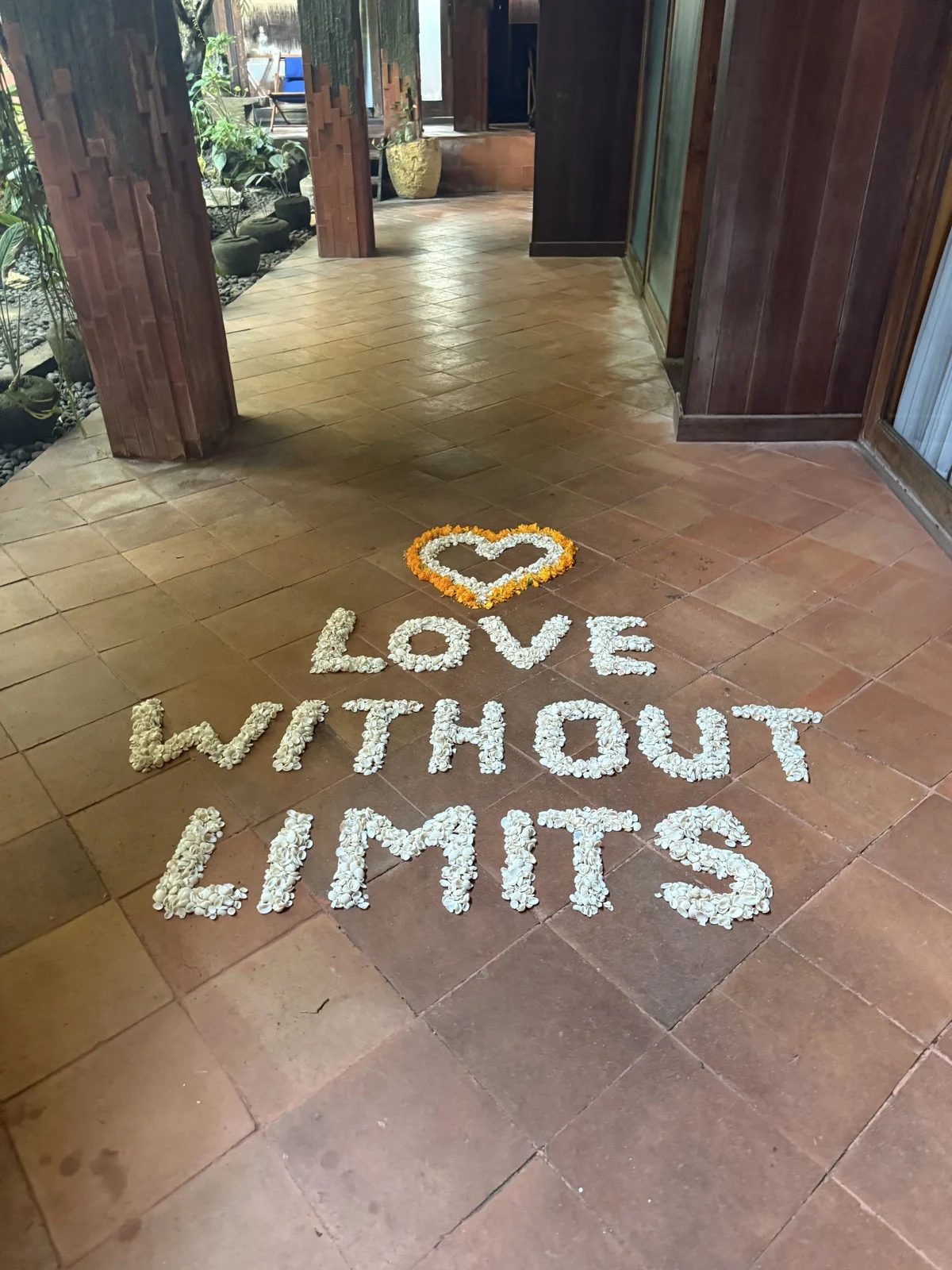
But five is still just a start. Ancient Sanskrit had dozens of distinct words for love, by some counts more than ninety, each naming a different flavor: devotion, playful affection, the ache of longing, selfless compassion, the love that asks for nothing back. I walked past a flower installation at the Udara Sunday Festival here in Bali that simply read "love without limits," and it struck me that this is the real hunger underneath the trend. Five languages is a beautiful on-ramp, not the destination. The more precisely you can name what you actually feel and need, the more honestly you can ask for it, and the more fully you can offer it.
Where They Fall Short
Here is the part the quizzes never mention.
The love languages describe the delivery of love. They say nothing about your capacity to receive it. And for a lot of us, that capacity is exactly where the trouble lives.
I have watched people get everything they said they wanted, in their exact language, and still feel unloved. The words of affirmation land and they think, "you are just saying that." The quality time happens and they spend it waiting for it to be taken away. If you do not believe you are worthy of love, no amount of someone speaking your language will get through, because you will deflect it, doubt it, or need it proven again tomorrow. This is the self-worth layer the framework skips entirely, and I wrote about it directly in what self-worth actually looks like in practice.
There is a second blind spot too. Your "language" is not always a pure preference. Sometimes it is a wound. Someone whose primary language is words of affirmation may actually be running an anxious attachment pattern that needs constant reassurance to feel safe. Someone who claims not to need much may be avoidant, calling self-protection a personality trait. The language is real, but underneath it there is often an attachment story worth understanding rather than just accommodating. If that resonates, start with your attachment style is not a life sentence.
The Deeper Thing Underneath
So do the five love languages work? Yes, as far as they go. Use them. Learn your partner's, tell them yours, and speak theirs on purpose. It is a genuinely good practice.
Just do not stop there and expect it to carry the whole relationship. The languages handle how love gets sent. They do not handle whether you can actually let it in, and that second part is the deeper work. It is built on knowing your own worth, understanding your attachment patterns, and stopping the quiet self-abandonment that makes even well-delivered love bounce off. That is the whole heart of what I explore in my book, Love Unlocked, and in my coaching.
So here is the question I will leave you with. You probably know your love language by now. But do you actually believe you deserve to be loved in it?

Ready to go deeper?
If this resonated, my book Love Unlocked goes past the surface into attachment, self-worth, and what conscious relating actually looks like in practice.
Want support with the deeper layer? I offer 1:1 Clinical Coaching and a 90-day container for people ready to actually let love in. Learn more at zacspowart.com.